A Guide to the Work of Damien Hirst
Hirst believes that the main part of creativity is the conception of the idea
27/03/2026
Damien Hirst is known as one of the most influential and controversial artists in modern British art. Born in Bristol in 1965 and growing up in Leeds. Hirst studied Fine Art at Goldsmiths, University of London. While at Goldsmiths in the late 1980s, he attracted attention by curating the 'Freeze' exhibition in 1988. This show included works by other young artists and led to the start of the Young British Artists (YBA) movement.
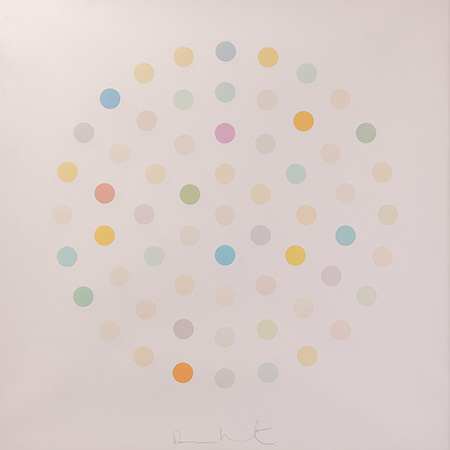
Damien Hirst 'Ciclopirox Olamine' (2004)
Hirst’s career took off after he met Charles Saatchi, who became an important patron. With Saatchi’s backing, Hirst had his first major solo show in 1991, where he showed some of his best-known pieces. As a student, Hirst worked in a mortuary, which sparked his interest in life, death, and mortality. These themes are central to his art, which often mixes ideas from art and science.
Among Hirst's most recognisable works is “The Physical Impossibility of Death in the Mind of Someone Living” (1991), which features a tiger shark suspended in formaldehyde. This installation, nominated for the Turner Prize, sparked the admiration and controversy that have surrounded his career. Another notable work, “Mother and Child (Divided)” (1993), presents a bisected cow and calf, each half displayed in glass cases. Showcased at the Venice Biennale, this work again sparked the artistic debate for which Hirst is famous.
In 2007, Hirst unveiled “For the Love of God,” a platinum cast of an 18th-century human skull encrusted with 8,601 diamonds. This extraordinarily extravagant piece became emblematic of Hirst's work and a cultural icon, sparking copycat imagery worldwide. In contrast to the spectacle of his installations, Hirst’s “Spot Paintings” series, composed of precisely arranged coloured dots, has also attracted marked attention but take a more minimalist approach, while remaining instantly recognisable and highly collectable.
Hirst is a prolific artist whose range includes public art, music videos, curating, and business projects like the restaurant Pharmacy. He often challenges traditional ideas about making art, using assistants and a factory-like method to produce his pieces. Hirst believes that the main part of creativity is the conception of the idea, not making the work by hand. This view has sparked debate about authenticity and artistic integrity, but it has also shaped his legacy.
Damien Hirst is reported to be the richest living UK artist. His pieces regularly fetch high prices at auction, with some works reaching multimillion-pound amounts. “For the Love of God” was reported to have sold for £50 million, setting a record for a living artist at the time. The “Spot Paintings” series, due to its scale and repetition, has produced numerous variations, some of which are more attainable for collectors, while others command significant sums.
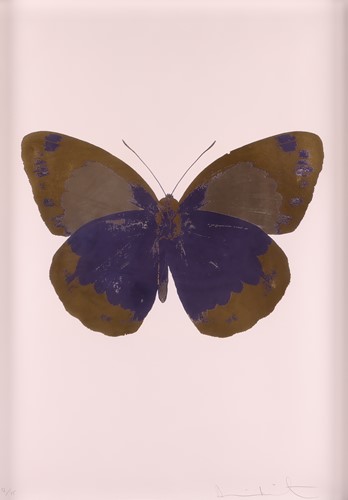
As an investment, ‘risk in Hirst’s market is linked to over-issuance rather than relevance. Value holds where supply has ended or consolidated’ (Carrington,2026, Myartbroker.com). Even so, his works continue to sell well at auction, as Hirst’s name and brand attract many eager collectors. Here at Dawsons, our expert team has sold several of his pieces; most recently a foil block print, The Souls II, which sold for £4000 (2025).
Related Articles
How Much is Contemporary Art Worth?
How Can I Sell an Art Collection?
Is Contemporary Art Important?
Buy & Sell Damien Hirst Art with Dawsons
Our team of art experts make it simple to sell art online or buy fine art at auction. Dawsons Auctioneers provide accurate valuations, competitive results, and trusted advice every step of the way. Get in touch today to find out what your art is worth.
Call us on 0207 431 9445 or email us on info@dawsonsauctions.co.uk